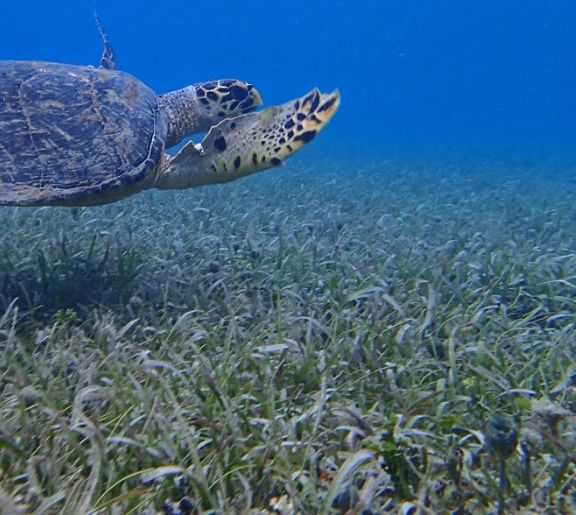
Seagrasses are found in shallow salty and brackish waters in many parts of the world. In the present, there are approximately 72 species of seagrass in the whole world, that belongs to 4 different families. The distinct feature that distinguish seagrass from seaweed is that seagrass have roots, leaves and underground stems called rhizomes that hold plants in place. They can form a dense underwater meadows, which some of the meadows are large enough to be seen from space!
One of the seagrass species that exist in Pulau Kapas is from the genus Halophila which provides food for dugongs. The seagrasses provide food for dugongs and green turtles as well as providing habitat for small marine organisms such as prawns and fishes. Moreover, seagrass can act as a bioindicator, since they are vulnerable towards any changes in their environment.
Seagrasses are also known as "lungs of the sea", since they can produce up to 10 liters of oxygen per square meter everyday, as a result from their photosynthesis! Other than that, the leaves of seagrasses are able to absorb nutrients and decelerate the speed of water flow, meanwhile the roots are able to stabilize the sediment, hence reduces erosion.